Your Changing Cycle in Perimenopause: What’s Normal, What’s Not
Is It Perimenopause?
For most of your life your cycle was a rhythm you could set a watch by. Now it reads like static — early, late, heavy, gone. Here’s how to tell ordinary perimenopause chaos from the kind worth a phone call.
Why cycles go haywire
Perimenopause is, at its core, the story of ovulation becoming unreliable. As it does, estrogen and progesterone stop rising and falling in their old coordinated dance. Early on, cycles often shorten — periods arriving closer together. Later, they stretch out, skip, and space past 60 days as you move toward the finish. The whole arc is laid out in the stages of perimenopause.
Irregular is the new regular — but “irregular” still has an outer edge, and it’s worth knowing where it is.
What’s typically normal
A wide range of change is simply part of the transition: cycles that run shorter or longer than your old 28 days, periods that are lighter or heavier than usual, skipped months followed by a return, and gaps that gradually widen over time. Unpredictability itself is the pattern. It’s disorienting, but it isn’t a sign something is wrong.
What’s worth a call to your doctor
There’s an outer edge, and these signs sit past it. They don’t mean something is seriously wrong — usually it’s something benign like fibroids or polyps — but they’re worth getting checked rather than waving off as “just perimenopause”:
Very heavy bleeding — soaking through a pad or tampon every hour for several hours, or passing large clots.
Periods lasting longer than seven days, or coming closer than every three weeks, consistently.
Bleeding or spotting between periods, or after sex.
Any bleeding after you’ve gone 12 full months without a period. Postmenopausal bleeding always warrants a prompt check — not a cause for panic, but never something to ignore.
Track it — for you and your doctor
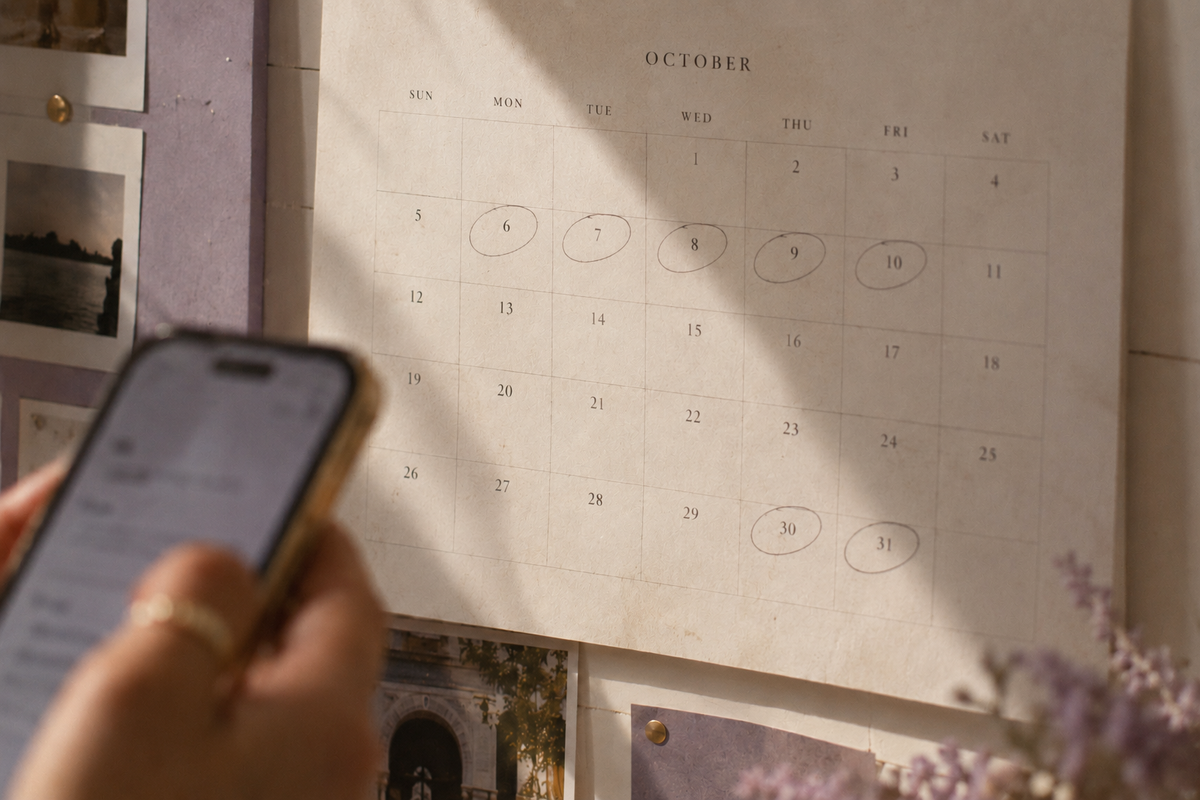
A simple log of when your period arrives, how long it lasts, and how heavy it is turns “it’s been all over the place” into real data your clinician can use. It also helps you spot when something’s crossed from ordinary into worth-a-call. Pair it with the broader symptom picture and you’ve got the full story.
Make sense of the chaos.
The free 2-minute quiz helps you place your cycle and symptoms on the perimenopause arc — so “all over the place” starts to make sense.
Take the Quiz*These statements have not been evaluated by the Food and Drug Administration. This product is not intended to diagnose, treat, cure, or prevent any disease. This article is for informational purposes and does not replace medical advice.